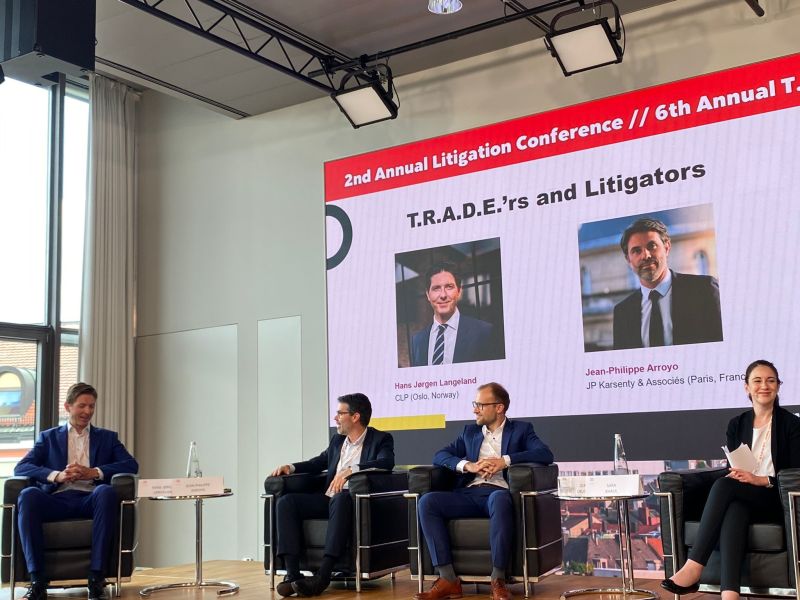
6th Annual T.R.A.D.E. Conference – AIJA – 22-24 June 2023

Jean-Philippe Arroyo was a speaker at the 6th Annual T.R.A.D.E. Conference organized by AIJA – International Association of Young Lawyers, held on June 22 and 24, 2023 in Munich, on the panel entitled “Dialogues between TRADE’rs and Litigators: “Did you consider that … ?” alongside Hans Jørgen Langeland, Jonas Laudahn, Sara Khalil, Marie Davy, and Gabrielle Guizard.

Many thanks to all the participants, who made for an enriching exchange on this theme, and a special thank you to AIJA for organizing this conference.

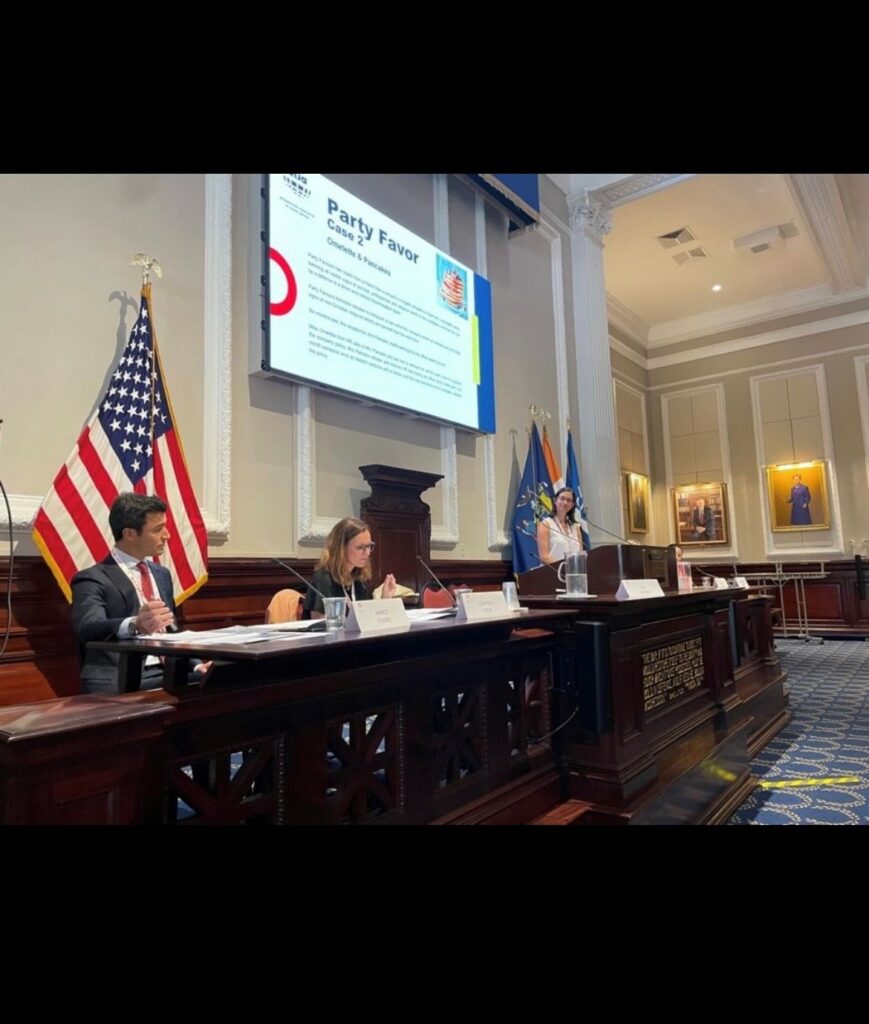
AIJA – Conference Breakfast in America – 14-16 June 2023- New York

Clémence Colin was a speaker during the Conference “Breakfast in America” organized by AIJA (International Association of Young Lawyers) which took place between June 14 and 16, 2023 in New York City, on the panel dedicated to “Religious Express in the Workplace: Legal Rights and Boundaries” alongside Nazanin Afshar, Astrid Caporali and Marco Tesoro and moderated by Pia Padfield.

Newsletter Intellectual Property – June 2023

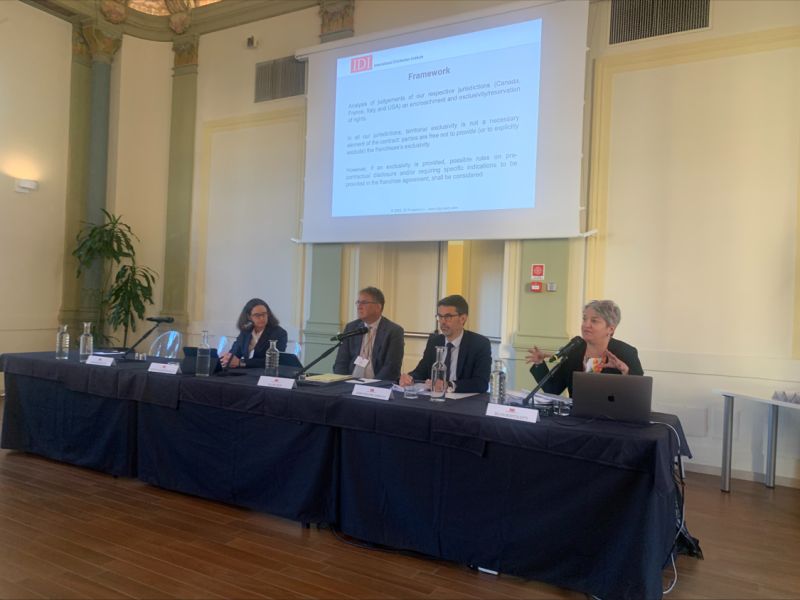
IDI Annual Conference – 9-10 June 2023

 Jean-Philippe Arroyo was a speaker during the Annual Conference organized by IDI (International Distribution Institute), which was held on June 9th and 10th 2023 in Bologna, on the discussions panel “Encroachment, breach of exclusivity and reservation of rights in franchise agreements”, alongside Allan Dick, Nicole Liguori Micklich, and moderated par Silvia Bortolotti.
 
Thanks to all the participants who enabled a fruitful exchange on this topic, and a special thanks to IDI for the organization of the event.

INFLUENCERS – Analysis of the modifications of the bill on influencers voted on 30 March 2023 by the French national assembly

On 30 March, the National Assembly voted on the bill aimed at regulating commercial influence and fighting against the abuses of influencers on social networks.

Several amendments have been integrated compared to the initial proposal commented in one of our previous FOCUS IP.

The main modifications to be retained are the following :

The legal definition of an influencer

The voted text no longer refers to a decree that would set a threshold of remuneration from which the qualification of influencer could be retained.

The definition retained is now the following:

Natural or legal persons who mobilise their notoriety among their audience to communicate content to the public by electronic means with a view to promoting, directly or indirectly, goods, services or any cause whatsoever in return for an economic benefit or any advantage in kind are exercising the activity of commercial influence by electronic means.”

Regulation of promotion for certain products and services

The scope of the sectors of activity concerned has been modified:

  • Tobacco and vaping sector: it is now expressly mentioned that influencers must comply with the prohibition of promoting tobacco and vaping products in compliance with articles L.3512-4 and L.3513-4 of the Public Health Code.

Influencers are also reminded of their obligation to comply with the Evin Law regarding the promotion of alcoholic beverages. The general prohibition initially envisaged is therefore set aside.

  • Health sector: in addition to the ban on the promotion of surgical procedures, the obligation to comply with the regulations on nutritional and health claims for foodstuffs has been added.

Above all, a much more general prohibition was added on “any direct or indirect promotion which undermines the protection of public health“.

The previous version of the Bill provided for a broader express prohibition, since it also covered pharmaceutical products such as medicines, contraceptives and foodstuffs intended for medical purposes.

  • Gambling sector: promotion by influencers is now subject to two technical criteria: (i) the use of platforms offering the technical possibility to exclude underage users from the audience; (ii) the activation of this functionality.

A specific clause will also have to be inserted in contracts with operators whereby influencers certify that they are aware of the laws and regulations applying to commercial communications relating to gambling and undertake to comply with them.

  • Sector of sweetened drinks or drinks with added salt or synthetic sweeteners or manufactured food products: influencers under the age of 16 are prohibited from promoting these products, as well as product placements in a programme targeting minors under 16.

In addition, the promotion will have to be combined with either (i) the form of presentation complementary to the nutritional declaration of the product, or (ii) health information.

Violation of the provisions concerning points 1, 2 and 3 would be punishable by 6 months’ imprisonment and a fine of EUR 300 000, instead of the 2 years’ imprisonment and EUR 30 000 fine initially provided for, unless the Consumer Code already provides for other penalties.

Regulation of the activity of influencer agents

The new text reinforces the protection of intellectual property rights.

An amendment now explicitly states that the influencer agent must take “all necessary measures (…) to avoid situations of infringement of intellectual property rights“.

The contract between the influencer and his agent will also have to include a specific clause recalling the rights and obligations of on the parties in terms of intellectual property rights.

Finally, the contract will have to be drawn up in writing only when it concerns a sum exceeding an amount set by decree.

The principle of joint liability between the advertiser and the influencer vis-à-vis injured third parties

The amendment aims to make the influencer more responsible and to encourage him to respect the rules relating to his activity, as well as to ensure better protection for the injured third party.


MARKETPLACE LIABILITY – French Court strengths the liability of online marketplaces by applying the status of editor rather than host

In a judgement dated 13 April 2023, no. 21-20.252, the Commercial Chamber of the French Supreme Court ruled that the online marketplace TEEZILY was an editor and overturned the judgement of the Court of appeal, which had ruled that it was an hosting provider.

The company TEEZILY commercialises products, clothes and other printed materials through its website www.teezily.com. It enabled designers to put their creations online for reproduction on the said products, to choose the availability duration, set the product price and a target number of buyers, and promote their product.  

The company SPRD.NET initiated a proceeding against the company TEEZILY for trademark infringement, violation of its database and unfair competition, noting that the company TEEZILY sold clothing and accessories identical to those it marketed and that it reproduced the “SPREADSHIRT” trademarks owned by SPRD.NET.

The company TEEZILY invoked the exemption of liability as a hosting company within the meaning of the French Law “LCEN”, which was upheld by the Paris High Court, rejecting all SPRD.NET’s claims.  

The company SPRD.NET appealed against this decision, but its claims were once again rejected by the Paris Court of Appeal.

In particular, the Court of Appeal had found that the following facts did not demonstrate an active role on the part of TEEZILY, excluding consequently the status of editor:

  • guiding the designer in setting the price of his product;
  • offering the designer technical support to “create your design in one click“;
  • publishing articles on general tips for each country to help designers in their advertising campaign;
  • providing a logistical service for the manufacture and delivery of the products, with the corollary that the designer has authorised TEEZILY to reproduce his work, and that the buyer has the related guarantees.

The Court also rejected SPRD.NET’s argument that TEEZILY was offering sales optimisation assistance to creators, on the grounds that there was no evidence of this. The screenshots provided in the submissions were of poor quality, did not mention TEEZILY’s name and were undated.

It concluded that TEEZILY’s role and conduct were neutral and purely technical and did not indicate knowledge or control of the data stored by it.

SPRD.NET therefore appealed to the French Supreme Court.

In its ruling of 13 April 2023, French Supreme Court overturned the decision of the Court of Appeal. It held that the company TEEZILY did not act as a hosting provider because it provided creators with a logistical service for manufacturing and delivering products, thereby playing an active role that gave it knowledge or control over the data relating to these offers.

Lastly, with regard to the illegibility of the screenshots produced in the submissions before the Court of appeal, the Supreme Court noted that the bailiff’s report also reproduced the screenshots, which were of better quality and should therefore have been taken into account by the judges.

TRADEMARK LAW – The operator of an online marketplace may be held liable for counterfeit goods sold on its marketplace

CJEU, Grand Chamber, 22 Dec. 2022, C-148/21 and C-184/21. In response to two preliminary questions raised by the Luxembourg and Belgian courts, the Court of Justice of the European Union (CJEU) considers that the operator of an online marketplace such as Amazon may be held directly liable for infringement of the rights of a trademark owner resulting from an announce by a third-party seller on its marketplace.

In the present case, Mr Christian Louboutin, the designer of shoes famous for their red outsole, noticed that the sites of Amazon, the distributor and operator of an online marketplace, have offers made by third-party sellers relating to shoes with red soles.

He also noted that Amazon not only published offers on its platform, but also handled the holding, shipping and delivery of these products whereas Mr. Louboutin had never given his consent to the circulation of such products.

Considering that Amazon was infringing his trademark, Mr. Louboutin initiated an infringement action against Amazon on the basis of Article 9§2(a) of Regulation 2017/1001 before the Luxembourg and Belgian courts.

These two courts then asked the CJEU about the interpretation of that article, in particular whether the operator of an online marketplace could be held liable for infringement of a trademark owner’s rights resulting from an offer made by a third-party seller on its online marketplace.

In a judgment of 22 December 2022, the CJEU, sitting as a Grand Chamber, gave a positive answer on condition that “a reasonably well-informed and reasonably observant internet user [….] establishes a link between the services of [the platform] and the sign in question“, i.e. when he has the impression that it is the operator of that platform who “commercializes, in his own name and on its own account, the goods“.

The CJEU then provides details on how this link can be established by the user between the platform and the trademark at stake. The mere fact of “creating the technical conditions necessary for the use of a sign and being paid for that service” is not sufficient to demonstrate use of the trademark by the operator.

It must be shown that the operator is using the trademark in the context of its own commercial communication, which must be understood to mean “any form of communication to third parties designed to promote its activity, goods or services or to indicate the exercise of such an activity“.

In this respect, according to the CJEU, the following may be taken into account:

  • the way in which the offers published on the platform are presented: a display showing the platform operator’s offers and those of third-party sellers at the same time, with its own logo both on the website and on all those offers “may establish a link, in the eyes of those users, between that sign and the services provided by that same operator”.
  • the nature and extent of the services provided by the platform operator: the handling of user queries, the storage and dispatch of goods and the management of returns are ” likely to give the impression, to a well-informed and reasonably observant user, that those same goods are being marketed by that operator, in its own name and on its own behalf“.

It will therefore be up to the national courts to analyse the platform’s commercial communications in detail and in practice to see whether they lead users to establish a link between the platform and the product in question.

COPYRIGHT – Validity of an “extensive” clause assigning intellectual property rights in an employment contract

Paris Court of Appeal, Division 5, Section 1, January 25th, 2023, no. 19/15256 – A clause in an employment contract progressively assigning intellectual property rights relatied to creations progressively as they are completed does not constitute a global assignment of future works.

In 2015 and 2016, an employee acting as fashion designer, who had entered a “stylist-artistic director” employment contract with OLT SAS, delivered services for third-party companies under collaboration contracts (or “co-branding”).

She considered that she was owed additional compensation for her services and requested that her claim be fixed as OLT SAS’s liability for the compensation of her patrimonial intellectual property rights, since the company had been placed in insolvency proceedings.

Article 8 of the employment contract, entitled “Intellectual Property”, provided that: “Ms. [A] [H] assigns exclusively to the Employer all intellectual property rights (reproduction and representation rights, excluding adaptation rights) relating to the works created within the scope of the present contract, progressively as they are completed. The present assignment covers all works protected in any way whatsoever by the Intellectual Property Code created by Ms. [A] [H] under the present contract.”

The employee considered that the copyright assignment clause was null and void, as it consisted in a global assignment of future works, prohibited by article L.131-1 of the French Intellectual Property Code.

The Court first held that the employee’s involvement in the co-branding contracts was part of her employment relationship with OLT SAS, to which she had granted the exploitation rights on her creations.

In the present case, the clause assigning rights set out in the employment contract to the employer’s benefit covered the creations completed under the contract, progressively as they were delivered.

The Court considered that such clause was not null and void since it “does not cover all the works that are the object of the assignment; moreover, it does not relate to future works but to completed works, since the assignment only takes effect progressively as the works are completed”. The clause as it was drafted therefore sufficiently delimited the scope of the assignment.

The Court also dismissed the invalidity of the clause despite the lack of any distinction between the compensation granted for the services delivered and the assignment of copyright.

This decision appears to be in line with a recent ruling by the Montpellier Court of Appeal (Montpellier Court of Appeal, October 18th, 2022, no. 20/04452), which held that the prohibition of global assignments of future works only applies to contracts covered by paragraph 1 of article L. 131-2 of the French Intellectual Property Code, i.e. performance, publishing and audiovisual production contracts.

Any confirmation by the French Supreme Court of this restrictive interpretation of article L. 131-1 of the French Intellectual Property Code shall be followed with interest.

PATENT LAW – An easier patentability of computer-implemented inventions

French Supreme Court January 11th, 2023, no. 19-19.567 & French Supreme Court January 11th, 2023, no. 20-10.935 – On January 11th, 2023, the French Supreme Court rendered two decisions in favor of recognizing the technical means of computer programs, and therefore their patentability.

Under French law, regarding computer-implemented inventions, article L. 611-10 of the French Intellectual Property Code provides that “computer programs” and “presentations of information shall not be considered as inventions”. However, paragraph 3 of the same article specifies that only patents concerning “one of these elements” are excluded from patentability. Therefore, software could in principle be patentable only if the invention in question has technical means.

The first case (French Supreme Court, January 11th, 2023, no. 20-10.935) concerned a French patent application filed by BULL for a “terminal establishing communications by broadcasting within a group“. The purpose of the invention, which had a military application, was to permit transmission of information on the status of each soldier in a combat unit, thus providing an overall view.

Regarding the second case (French Supreme Court, January 11th, 2023, no. 19-19.567), the French patent application was filed by THALES for a time-based display of an aircraft’s mission. The aim of this patent was to improve the display of information in cockpits, in order to facilitate the reading and correlation of data relating to the stages of an aircraft mission.

Both patent applications were rejected by the Director of INPI for lack of technical character.

Following an appeal, the Court of Appeal overturned these decisions considering that both patent applications have a technical character.

In both cases, the Director of INPI appealed to the French Supreme Court.

In the “THALES” case, the French Supreme Court disapproved the Court of Appeal’s decision considering that the Court of appeal did not provide a legal basis for its decision, holding that the Court asserted the existence of a technical character of the invention without establishing the existence of a technical contribution or explaining in what way the means were technical.  

In the “BULL” case, the French Supreme Court dismissed the appeal, ruling that it was clearly not of such a nature as to lead to cassation.

The French Supreme Court seems to be in favor of patenting computer-implemented inventions, but only if the assessment of the technical character of the patent application is well explained and motivated.

Both decisions of the French Supreme Court issued on January 11th, 2023, are debated, as the inventive activity of both patent applications appeared to be rather weak. According to observers, these decisions demonstrate the alignment of French case law with the practice of the European Patent Office in admitting the patentability of computer-implemented inventions regarding the inventive activity.

It is important to keep in mind that both of these two cases were introduced before the law “PACTE” came into force. Article L. 612-12 7° of the French Intellectual Property Code now requires the INPI to examine the inventive step of the patent application, which was not the case when the Bull and Thales patents were examined. It is possible that such examination would have ruled out the patentability of the two inventions in question.

Newsletter

Subscribe to our newsletter to be informed of our news

Privacy Overview

This website uses cookies so that we can provide you with the best user experience possible. Cookie information is stored in your browser and performs functions such as recognising you when you return to our website and helping our team to understand which sections of the website you find most interesting and useful.